“In some parts of the world, menarche is a day that young menstruators may learn to dread. A first period can hold the weight of signifying the transition from girlhood to womanhood, and it is often the single event that leads to a girl’s dropping out of school, getting married early, undergoing female genital mutilation, or in some places even being forced into social isolation.”
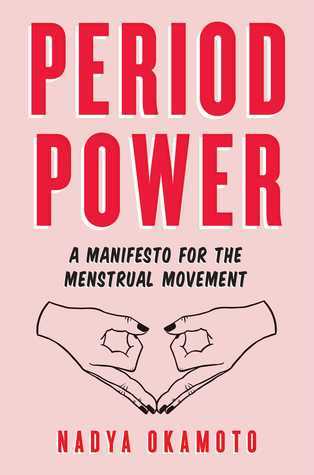
Period Power: A Manifesto for the Menstrual Movement by Naday Okamoto
Nadya Okamoto’s Period Power is full of inspiring pages from beginning to end. It’s a very well researched, heavily informed book that covers so many topics such as:
- Period products
- The history of period stigma in the U.S
- Period poverty
- Period policy
- Menstruation in the media
- How to take action
The majority of the book focuses on the effects of period poverty in the U.S. I was surprised to read about the statistics and the policies in place in the United States that currently make it hard for menstruators to access period products. This got me curious about what the situation is like here in Canada. The teachings shared by Okamoto on the struggles that my fellow menstruators face just south of the border, inspired me to explore the current situation here in Canada. I wanted to take action as a newly minted period warrior by arming myself with information about the policies and struggles in the country I call home. Here’s a mini breakdown of what I found out:
No More Tampon Tax
Firstly, what is a tampon tax ? Basically, hygiene products and products considered a basic necessity are not taxed unless of course they are period products (tampons, sanitary pads, menstrual cups e.t.c) because period products are considered a luxury. Or at least they were considered a luxury up until July 1, 2015 when the Canadian federal government announced the tax on ‘feminine’ hygiene products will be lifted.
Even though it’s now been four years since we said goodbye to the tampon tax, access to menstrual products is still a huge problem! Which leads to our next topic..
Period Poverty
According to a Global News article, one-third of Canadian women under the age of 25 struggle to afford menstrual products. Period poverty extends far beyond financial implications, the inability to access menstrual products has severe social and emotional implications as well. The Toronto Sun reports “nearly one in seven Canadian girls has either left school early or missed school entirely because she did not have access to period products.” In addition to that, a survey by Plan International Canada found that 83 percent of women feel that their period prevents them from fully participating in activities.
The issue is even worse for those affected by homelessness. For homeless menstrautors, managing a period often means having to choose between buying menstrual products or going without food. In some cases, some menstruators end up using make-shift solutions, like making pads out of toilet paper, newspaper and even cardboards! In other cases, menstruators end up using tampons or pads for much longer than they should which could lead to severe health consequences such as toxic shock syndrome ( a rare, life-threatening complication of certain types of bacterial infections.)
Period poverty affects the physical and mental health of many Canadians, so what can we do to make things better?
Period Policy & Taking Action
Use your voice. How did Canada end up eliminating the tampon tax in 2015 ? It was the result of thousands of Canadians making their voices heard and demanding change!
Some more recent break throughs in the fight to end period poverty:
- Earlier this year, the government of British Columbia announced that by the end of 2019, all B.C public schools will be required to provide free pads and tampons for their students. You can read more about this great news here.
- In May 2019, the Canadian government proposed making some employers offer free menstrual products at work, the same way soap, warm water, toilet paper are readily accessible. Read more about the proposal here.
- In March 2019, the Toronto city council agreed to spend an additional $222,000 to provide city-run shelters and some community centres with menstrual products. Read more about it here.
While the creation and implementation of laws and policies are the best way to make long lasting change, the process of getting those policies into effect can also be, well, ..long lasting. In the meantime, there are so many ways we can make a difference. You can support your local homeless shelters or find a non-profit or charitable organization that is working towards ending period poverty.
Fighting to end period poverty means fighting to end period poverty for everyone, regardless of their race, religion or gender. One of the things Okamoto’s Period Power book made clear to me was the direct correlation between the:
Menstrual movement and Intersectional Feminism
What is Intersectional Feminism? “Intersectional feminism examines the overlapping systems of oppression and discrimination that women face, based not just on gender but on ethnicity, sexuality, economic background and a number of other axes.”
The Huffington Post
Okamoto describes Intersectional Feminism as a movement that is “more inclusive of those beyond the gender binary, of all races, and of all socioeconomic backgrounds.” She includes an excerpt from Cass Bliss, a non-binary trans educator aka “The Period Prince” who is a leading expert in trans- inclusive activism.
Cass’s guide to making your (period) activism more inclusive include:
1. Listen and Learn
It’s important to listen to the experiences of trans and non-binary folks in your community. Trans and non-binary people face menstrual challenges that are foreign to the average cisgender person. For example, having to decide which bathroom is safe to use while menstruating; trying to smuggle a tampon in and out of the men’s room e.t.c.
2. Check Your Language
Be cautious of the pronouns and terminology you use when referring to people who menstruate. Constantly using “she” pronouns or the term “women” when referring to people who menstruate leaves out an entire population of menstruators who are already marginalized. You can use inclusive terms such as: ” people with periods” or “menstruators” instead of “girls” or “women”. “Menstrual health products” or “Period products” instead of “Feminine hygiene products.”
3. Fight for Equal Access
While progress is being made in making period products easily accessible in public bathrooms etc, it’s important to remember to include these products in men and gender-neutral stalls/restrooms.
4. Ensure Representation
When making or promoting period products, take into consideration the diversity of the menstrual population. Make sure your products vary in style and size. When organizing events, make sure your presenters are representative of the menstrual population.
And that’s the mini breakdown folks! I hope this little summary has made you a little more aware of the reality of period poverty and how to be purposeful and inclusive in your activism. I strongly recommend picking up Okamoto’s ‘Period Power’ to learn more about the period movement. Now go forth and be a period warrior!

 Dreaming of Book Pages