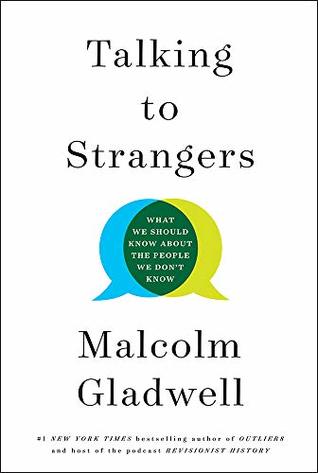
My rating: 2.5/5 stars
Finished this one. I think it’s overhyped.
There are interesting concepts backed by research described in this book. For example, I liked reading about the research surrounding how we can easily misunderstand people/misinterpret intentions due to mismatching behaviours. So for example, we think someone who is sad or guilty is meant to look or act a certain way – so when they don’t look or act that way, we then misinterpret their behaviour as something else. Gladwell also talks about “default to truth” which is that in general, we tend to believe people until we have enough doubt or reason to question our belief in them. Now all of this was intriguing and made sense when paired with some of the cases detailed in the book that involved: government spies, psychology students etc. What I didn’t like about this book was everything else.
Gladwell starts off this book talking about Sandra Bland – from the very first page it is implied that Sandra Bland’s death was the result of a misunderstanding between strangers…

…but Gladwell then mentions that he will return to this case by the end of the book and even prompts the reader, throughout the book, to keep the Sandra Bland case in mind. So I kept on reading. But then every time I would read what seemed like an interesting concept, the next chapter would feature another tone-deaf example.

He refers to a number of high profile sexual assault cases (Brock Turner, Dr. Nassar, Jerry Sandusky) to establish ways people can misinterpret body language, communication and again the idea of “default to truth”.
In Gladwell’s attempt to try and portray the science of body language, communication, etc he was either intentionally or unintentionally failing to see the irony in his analysis. Surely while writing he would have realized that “default to truth” doesn’t seem to be applied to victims? Why is that? Why does society instead automatically doubt that victims are telling the truth? There was no acknowledgement or analysis of this. Moreover, in his entire analysis of the Sandra Bland case and other instances of policing he never once mentions police brutality or racial profiling as a contributing factor.
But then again maybe that wasn’t the point of this book. Maybe Gladwell solely wanted to highlight the impact of miscommunication and judgement in everyday situations. But to talk about sexual assault and policing without clearly acknowledging victim blaming, police brutality and institutional racism is to diminish the severity of those issues. And to close out the second last chapter with “The death of Sandra Bland is what happens when a society does not know how to talk to strangers.” is not only a reach but incredibly insulting.
 Dreaming of Book Pages